There is a small but important difference between eating the biscuit beside your cup and getting up, finding your shoes and walking to the shop for another one. Both actions end with a biscuit. Only the second tells an observer much about the trouble you were willing to take. When scientists investigate the familiar hunger that can follow cannabis, that distinction becomes surprisingly useful.
A bowl of snacks can answer how much someone ate. A taste rating can answer how much they liked it. To find out what the food was worth to them, you need to put something between the eater and the food. In one study combining observations in people with experiments in rats, the researchers did exactly that. The identity of the species doing the work is important here.
First, put the snacks within reach
In the human part of the study of vaporized cannabis and eating, participants had access to snacks and drinks. During the first half hour of access, people consumed more energy after THC-dominant cannabis than after placebo. Their taste ratings showed no corresponding effect of cannabis, and the balance of energy from carbohydrate, fat and protein remained broadly similar across conditions.
An unchanged proportion can sound like an unchanged diet until you consider the portions. If somebody eats more of everything on a tray in roughly the same proportions, the proportions will tell you very little about the extra energy consumed. And a biscuit that rates seven out of ten on two visits may still be worth a second helping on only one of them.
Earlier residential laboratory research took advantage of being able to observe meals and snacks across the day. Such a setting can reveal which eating occasions account for extra intake. It still leaves open what somebody would do if each additional bite required more effort than the last.
Raising the price, one press at a time
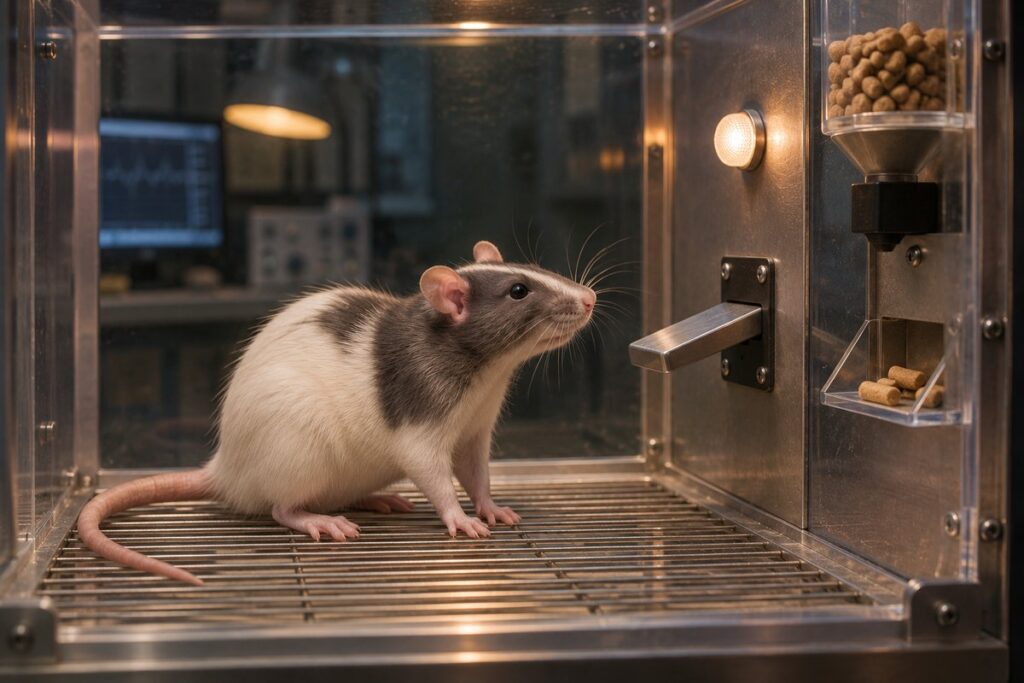
The later team asked the effort question in rats. The animals learned to press a lever to obtain a sugar reward. Then the researchers used a schedule in which the number of presses required increased with successive rewards. An animal could collect an early reward relatively cheaply. Keeping at the task as the price rose provided evidence about its willingness to work for the next one.
This design changes the meaning of pressing. A count of presses at one fixed price might tell you how quickly an animal learned the task or how much time it had at the lever. Increasing the price lets you ask when the animal gives up. The broader literature on animal reward tasks explains why researchers use this stopping point as an indicator of motivation. A creature’s ability to move, its previous training and whether it has recently eaten still matter to the interpretation.
The researchers found evidence in rats that cannabis increased motivation for food. Their broader feeding experiments also let them watch how quickly animals started eating and how often they returned to eat. The human volunteers, meanwhile, had been offered food within reach. No one in that study had to walk to the shop, press a lever or earn another biscuit. Giving the human volunteers credit for the rats’ hard work would make the result sound more conclusive than it was.
What an appetite hormone can add
Another human laboratory study measured hormones related to appetite and metabolism after cannabis given by different routes. A blood sample can show how a biological signal changes over time. It cannot tell the observer how far a person would walk for a snack, any more than an empty plate can reveal the person’s hormone levels.
A revealing human experiment would put a cost on obtaining successive portions, while also measuring taste and consumption. Then a volunteer who kept working for a snack whose taste rating hadn’t budged would have answered two questions at once. For now, we know that the people ate more, and that the rats were prepared to work harder. Those are interesting findings precisely because they are distinguishable.