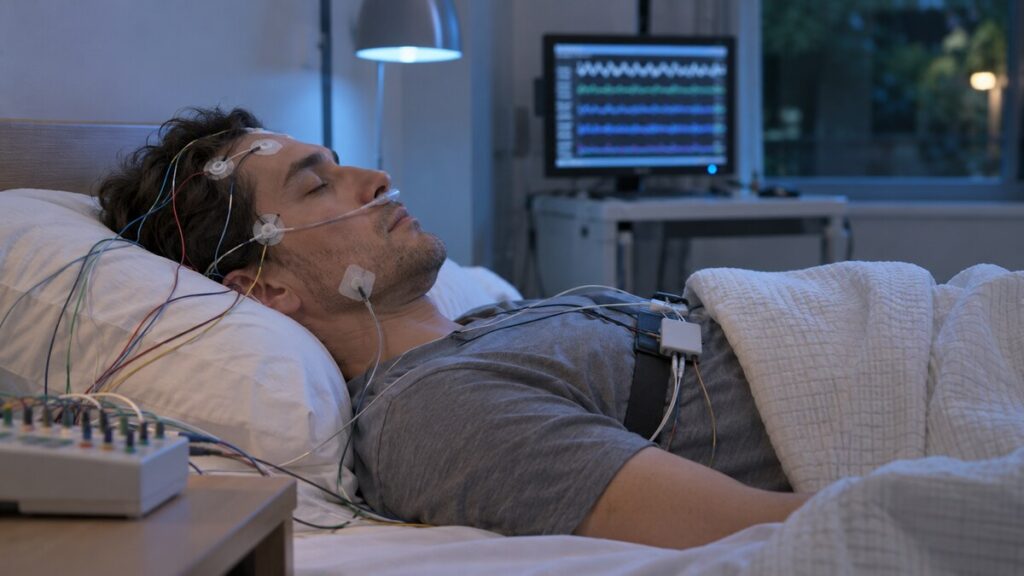
On the morning questionnaire you write that you slept beautifully. The technician in the next room sees several awakenings that you do not remember. Both observations can be correct. You are reporting what the night felt like and how you feel now. The technician is classifying a sequence of electrical and physiological signals. The gap between the two records is especially interesting in studies of cannabis and sleep.
What the sleeper knows
Only the sleeper can say whether the night felt restful, whether lying awake seemed distressing or whether they remember dreaming. A diary can record those experiences repeatedly in someone’s own home. It can also pick up a benefit that matters to that person even when a laboratory measure barely changes. The difficulty comes when a report about experience is used to answer a question about minutes spent in particular stages of sleep.
Suppose the last thing someone remembers is feeling drowsy on the pillow. They might estimate that they fell asleep almost immediately. A recording might show a longer interval before sleep began. The reverse discrepancy is also possible. A person can feel as though they lay awake for an hour while the recording includes periods classified as sleep. A question about drowsiness before bed and a question about sleep after lights out therefore need separate entries in a study.
Following an ordinary night through wires
Polysomnography combines several signals, including electrical activity from the brain, eye movements and muscle activity. Researchers use them to identify stages of sleep, estimate the time to fall asleep and count interruptions. A systematic review of cannabis and sleep architecture examined evidence from studies that measured such outcomes. Across studies, the evidence for a consistent change in rapid eye movement sleep after cannabis exposure was mixed. A familiar explanation about cannabis universally suppressing REM sleep turns out to be much neater than the measurements.
Ten extra minutes of what?
Imagine that volunteers spend ten more minutes asleep on a test night. The additional time could come from falling asleep earlier, spending less time awake in the middle of the night or waking later in the morning. The total alone leaves all three possibilities open. For someone distressed by lying awake at bedtime, the first might matter more than the others. For a shift worker with a fixed alarm, the last may offer no practical benefit at all.
Those examples also explain why combining studies takes care. A questionnaire about satisfaction, a report of how long it took to fall asleep and a machine’s estimate of REM duration are not three interchangeable units of better sleep. A review of recreational cannabis use and sleep in the general population addresses another complication. Outside the laboratory, people who already sleep poorly may be especially likely to use cannabis in the hope of improving sleep.
Which night did the researchers choose?
The first night after administration, an ordinary night during regular use and a night soon after stopping each have a different history. Research on sleep during abstinence specifically recruited people who had previously experienced sleep difficulties when they stopped using cannabis. That choice makes sense for investigating the difficulty. It would be a poor way to estimate how everybody who has ever used cannabis will sleep.
The morning questionnaire and the technician’s chart deserve to stay side by side. If the questionnaire improves and the chart does not, the next question is which part of the person’s experience changed. Perhaps bedtime felt easier. Perhaps awakenings were less memorable. Perhaps the measurements missed what mattered that night. Keeping the two records separate gives scientists a chance to find out why someone can feel sleepier at bedtime, report a better night and still show remarkably little change in the architecture of sleep.